
Passive Optical Network (PON) technology is the backbone of modern fixed broadband, enabling high-speed fiber connectivity across residential, enterprise, and mobile backhaul segments. The PON market is undergoing a significant generational shift — from GPON’s widespread dominance to the rapid ascent of XGS-PON, with 25G and 50G PON emerging as the next frontiers.
The PON equipment market was valued at USD 35.29B in 2025 and is forecast to grow to USD 61.49B by 2031 (a 9.70% CAGR for 2026–2031, per Mordor Intelligence). Separately, Fortune Business Insights pegs the broader Passive Optical Network (PON) market at USD 15.50B in 2024, growing to USD 48.07B by 2032. On the technology mix, XGS-PON is widely viewed as the primary mass-market upgrade path through at least 2030 (Dell’Oro), reflecting operator demand for symmetric multi-gig capacity. Meanwhile, 50G-PON is entering early commercialization but is expected to ramp more gradually, with broader scale tied to component-cost reduction and higher-volume deployments later in the decade.
PON Technology Comparison
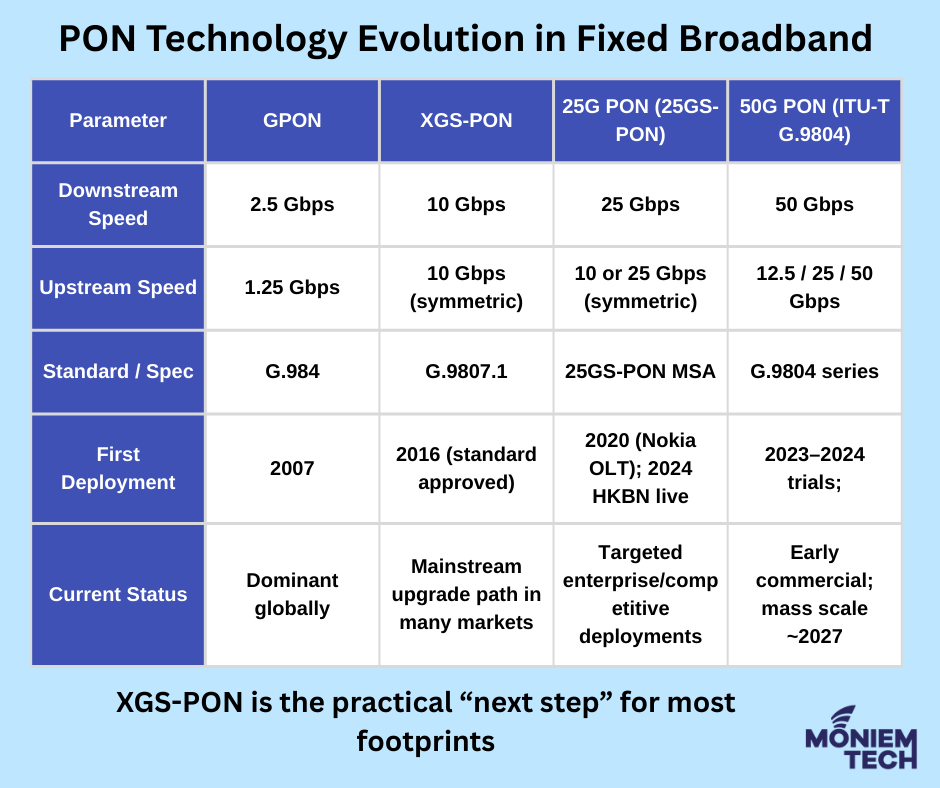
Each generation of PON technology follows a pattern of approximately 4× bandwidth improvement over its predecessor, roughly every 9–10 years. The table below summarizes the four primary technologies in today’s fixed broadband landscape:
Market Dynamics & Technology Transitions
GPON: Enduring Foundation
GPON (Gigabit Passive Optical Network) is the established “workhorse” PON architecture in FTTH, using a point-to-multipoint optical distribution network (ODN) with a shared downstream broadcast and TDMA-based upstream, coordinated by the OLT via dynamic bandwidth allocation (DBA). The GPON PMD layer defines a nominal 2.488 Gbit/s downstream and 1.244 Gbit/s upstream line rate, enabling cost-efficient mass broadband with QoS-aware transport of Ethernet and TDM services via the GPON Encapsulation Method (GEM).
In practice, the primary design constraint for GPON in modern networks is upstream capacity and concurrency headroom (e.g., multi-user video calls, cloud backup, Wi-Fi 6/7 peak aggregation). This often leads to choosing selective overlays instead of complete ODN overhauls.
Despite being “older” tech, GPON remains the baseline for capital efficiency. For operators in price-sensitive markets or serving low-bandwidth residential users, it offers the lowest cost-per-subscriber. However, its limited upstream headroom means it is increasingly becoming a bottleneck for modern home offices and Wi-Fi 7 integration, forcing a strategic shift toward selective overlays rather than total replacements.
XGS-PON: The Ascendant Standard
XGS-PON (10 Gigabit Symmetrical Passive Optical Network) is the mainstream evolutionary step from GPON, preserving the same basic PON sharing model (broadcast downstream, TDMA upstream, DBA scheduling) while raising capacity to 10 Gbit/s symmetric (10/10) at the physical layer.
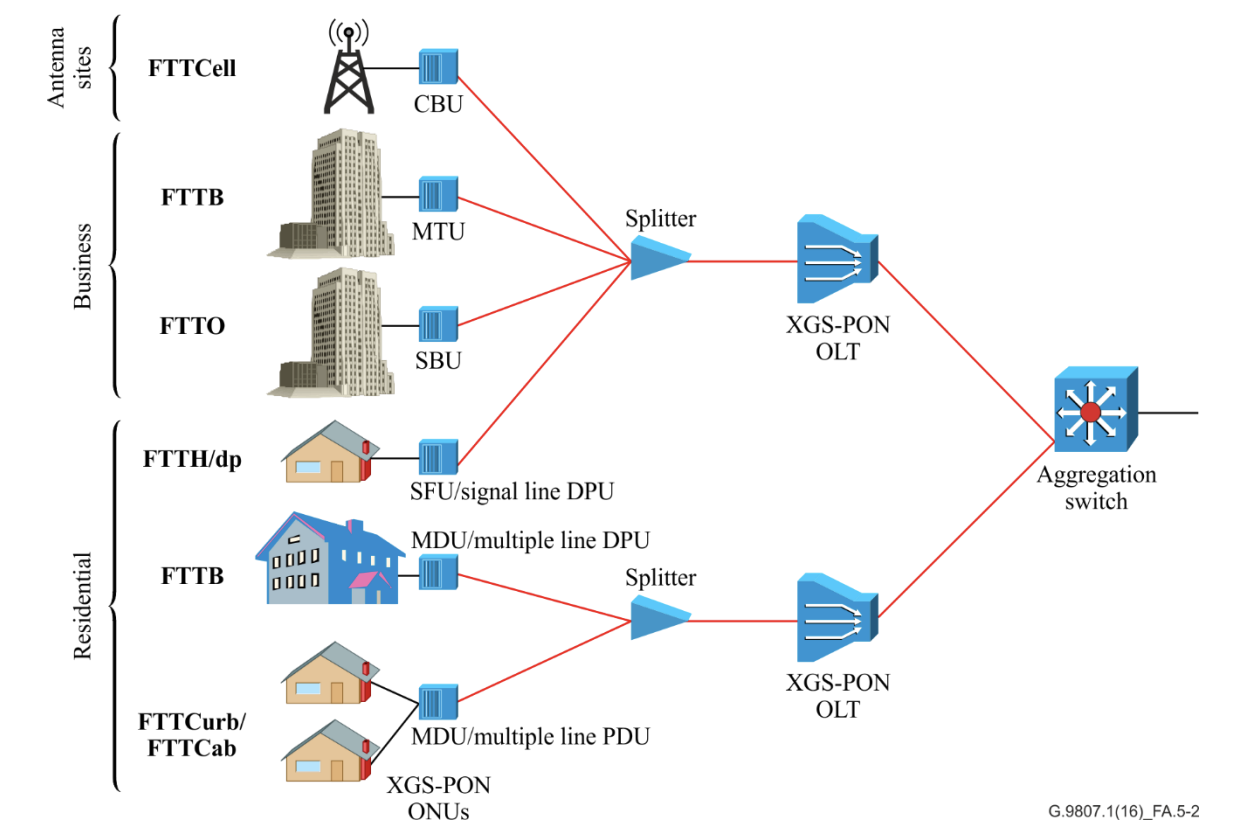
The key technical benefit for fixed broadband is not only higher peak rates, but materially more upstream headroom for symmetrical multi-gig tiers and business-class access, while still allowing operators to reuse the passive ODN and migrate customers by swapping OLT/ONT optics and CPE as needed. XGS-PON is also commonly positioned for convergence use cases (residential, business, and mobile backhaul) because the standard explicitly targets those environments.
XGS-PON is the mainstream mass-market upgrade path. Most new FTTH builds, and major upgrade programs in North America and parts of EMEA are centered on 10G symmetric PON to enable multi-gig tiers and stronger upstream capacity. Dell’Oro also expects XGS-PON to be a primary driver of spending on broadband access equipment in this period.
This is the “sweet spot” for ROI right now. By offering symmetrical speeds, operators can market “Pro” tiers that appeal to content creators and remote professionals. Crucially, because it reuses existing fiber plants, it enables a seamless migration path, allowing operators to spend capital only on electronics (OLT/ONT) when customers actually upgrade, thereby protecting cash flow.
25G PON: Competitive Differentiator
25G PON (25 Gigabit Passive Optical Network) is defined by an industry MSA to accelerate interoperable 25G-class access using an “ITU-style” PON framing/control approach while leveraging 25G optics/PHY building blocks.
A key technical nuance is that 25GS-PON supports 25G downstream and can be implemented with 25G upstream for symmetric operation (and, depending on system profile, other upstream options), making it attractive for premium residential multi-gig, dense neighborhoods, and enterprise tiers where 10G-class systems begin to face contention/engineering limits. Operators typically view 25G as a targeted overlay to extend headroom before 50G economics become compelling at scale.
25G PON remains a targeted overlay, not a default footprint choice. 25G-class access is primarily used as a competitive differentiator for premium residential tiers and for selective enterprise/wholesale cases where additional headroom beyond 10G is needed. Upgrade economics depend on the vendor platform (some architectures can reuse chassis and add new optics, but this is not universally “just optics” on any existing XGS line card).
25G PON acts as a smart “speed shield” protecting operators from competitors. It enables them to provide lucrative enterprise services, like 10G or 20G dedicated lines, over the same network used by residential customers. This makes it an excellent choice for operators looking for more capacity than XGS-PON can offer currently, without waiting for the 50G PON costs to become more affordable.
50G PON: The Next Generation Horizon
50G-PON is the ITU-T next-generation access system designed for very high capacity over the same point-to-multipoint ODN model, with a nominal 50 Gbit/s downstream and defined upstream options including 12.5 Gbit/s and 25 Gbit/s (and additional upstream evolutions in the series). Technically, 50G-PON introduces more advanced PHY requirements (including DSP at the physical layer in typical implementations) to deliver higher spectral efficiency and robustness while maintaining coexistence strategies with earlier generations on the same fiber plant.
For fixed broadband, 50G-PON is positioned as the scale solution for widespread premium multi-gig tiers and convergence (residential/business/mobile transport), but is commonly deployed first in selective high-demand areas due to optics/line-card economics.
50G-PON moves from trials into early commercial deployments, but volume ramps are cost-gated. Dell’Oro commentary indicates the 50G ramp is slower than earlier expectations, with operators continuing to buy large volumes of GPON/XGS gear near term; broader scale is expected later as component costs decline with higher volumes.
This represents the long-term future-proofing of fiber. While current component costs make it expensive for mass residential use, it is the ultimate solution for network convergence—where one fiber line carries residential data, business services, and 5G mobile backhaul. For operators, the current challenge is timing: jumping to 50G too early risks overpaying for hardware, but waiting too long could leave them leapfrogged by more aggressive competitors.