
When discussing 5G, most conversations focus on higher throughput, lower latency, and support for massive device connectivity. While these capabilities are important, one of the most significant advancements in 5G lies beneath the surface: security.
As mobile networks advance from offering consumer broadband to enabling critical infrastructure, industrial automation, autonomous systems, and mission-critical communications, their security architecture must also develop. The 3GPP standards for 5G incorporate several improvements aimed at tackling vulnerabilities found in earlier generations, especially LTE.
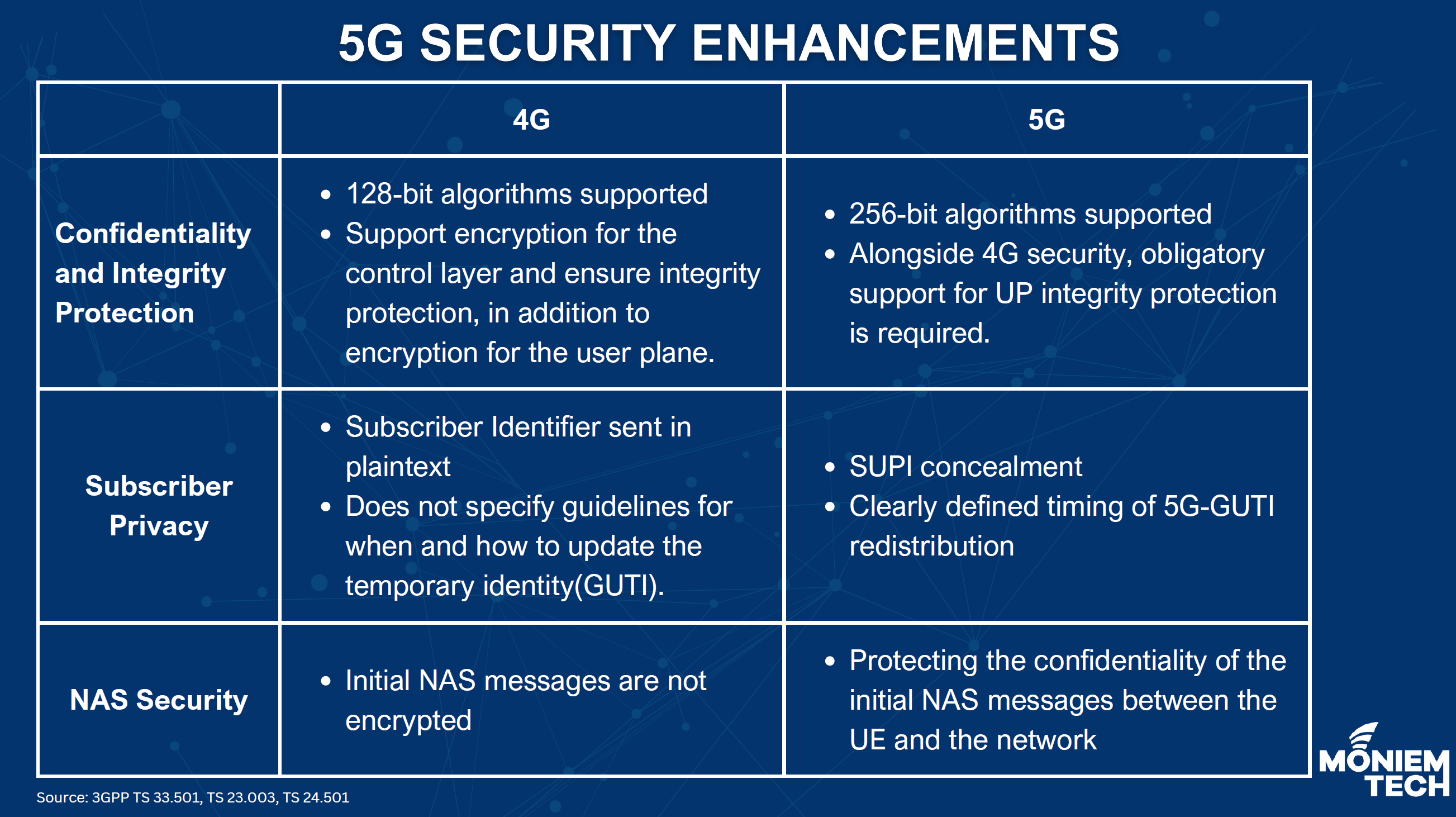
Stronger Confidentiality and Integrity Protection
LTE introduced robust security mechanisms based primarily on 128-bit cryptographic algorithms. While these algorithms remain secure, 5G expands the security framework by supporting 256-bit cryptographic algorithms, providing stronger protection against future computational threats.
More importantly, 5G extends integrity protection capabilities beyond the control plane. In LTE, integrity protection was primarily applied to signaling traffic, while user-plane traffic relied mainly on encryption. 5G introduces user-plane integrity protection capabilities, enabling operators to verify that transmitted data has not been modified during transport.
This enhancement becomes increasingly relevant in industrial and mission-critical deployments where data manipulation could have operational or safety consequences.
Practical Impact
Consider a private 5G network controlling autonomous robots in a manufacturing plant. Encryption protects data confidentiality, but integrity protection ensures that control commands have not been altered before reaching the robot. This additional layer of trust is particularly valuable in Industry 4.0 environments.
Enhanced Subscriber Privacy
One of the long-standing privacy concerns in cellular networks has been the exposure of permanent subscriber identifiers.
In LTE networks, under certain circumstances, the International Mobile Subscriber Identity (IMSI) could be requested and transmitted, creating opportunities for IMSI-catcher attacks using rogue base stations.
To address this issue, 5G introduces the Subscription Permanent Identifier (SUPI) and the Subscription Concealed Identifier (SUCI). Instead of exposing the permanent identity directly over the air interface, the identifier is concealed using public-key cryptography before transmission.
This architectural change significantly reduces the risk of subscriber tracking and identity harvesting.
Practical Impact
Security researchers have demonstrated IMSI-catcher devices capable of collecting subscriber identities in legacy cellular networks. By concealing the permanent identity, 5G raises the barrier against such attacks and improves user privacy.
Improved NAS Security Procedures
Non-Access Stratum (NAS) signaling forms the foundation of communication between the user equipment (UE) and the core network. Registration procedures, mobility management, authentication, and session establishment all depend on NAS messages.
In LTE, portions of the initial signaling exchange occurred before security contexts were fully established, limiting the protection available during the earliest stages of network attachment.
5G introduces enhanced procedures that better protect sensitive information during registration and authentication while reducing exposure during initial access procedures.
The result is a more resilient signaling framework designed to withstand increasingly sophisticated attack techniques.
Practical Impact
As mobile networks become the communication backbone for smart cities, connected transportation systems, and critical infrastructure, securing signaling traffic becomes as important as protecting user data itself.
Why These Changes Matter
The significance of 5G security enhancements becomes clearer when considering the shift in network usage. Previous generations primarily connected smartphones and consumer devices. In contrast, 5G is expected to support:
- Industrial automation systems
- Smart factories
- Autonomous vehicles
- Utility infrastructure
- Healthcare applications
- Public safety communications
- Massive IoT deployments
In these environments, security failures may result not only in data breaches but also in operational disruptions and safety risks. Therefore, many of the security improvements introduced in 5G are not simply incremental upgrades. They represent a strategic redesign of the mobile security architecture to support a future where mobile networks become critical infrastructure.
Conclusion
While speed and latency often dominate discussions about 5G, the evolution of security may ultimately prove to be one of the technology’s most important achievements. Through stronger cryptographic options, improved subscriber privacy mechanisms, enhanced integrity protection, and more secure signaling procedures, 5G provides a foundation better suited to the demands of modern digital ecosystems.
As operators continue to deploy standalone 5G cores and enterprise private networks, these security capabilities will become increasingly important for enabling trusted, resilient, and scalable connectivity.