The D2D satellite market is evolving through distinct implementation paths — proprietary, pre-standard, and 3GPP-defined. Understanding the difference is key to navigating what’s real, what’s coming, and what belongs to which ecosystem.
Conversations about direct-to-device (D2D) satellite connectivity frequently collapse very different technologies into a single category. Apple’s emergency SOS, Starlink’s T-Mobile partnership, and Skylo’s IoT network are all described as “satellite connectivity” — but they operate under fundamentally different architectures, spectrum regimes, and standards frameworks.
Breaking the market down into three distinct implementation models helps clarify what is actually being compared.
Model 1 — Proprietary satellite-to-device
Uses proprietary technology and legacy satellite spectrum to deliver narrowband consumer services — primarily SOS alerts and basic messaging — without any dependency on terrestrial mobile operator infrastructure.
Example: Apple + Globalstar
These solutions are vertically integrated end-to-end. Apple’s iPhone satellite features are phone-to-satellite services optimized for emergency and off-grid scenarios. The experience is seamless precisely because the full stack — device modem, spectrum, and ground infrastructure — is purpose-built for a narrow, well-defined use case.
Model 2 — Pre-3GPP direct-to-cell
Connects existing, unmodified smartphones to coverage from space using mobile operator spectrum. Doppler compensation and timing complexity are handled at the satellite network level, not by the device.
Example: Starlink + T-Mobile, AST SpaceMobile + AT&T / Verizon
This approach is commercially compelling because it requires no hardware changes to the device and leverages licensed MNO spectrum already associated with subscriber identity. The satellite effectively acts as a flying cell tower, presenting itself to the phone as a standard base station. The engineering challenge — compensating for the Doppler shift and signal delay caused by the low Earth orbit at high speed — is handled by the space segment.
Model 3 — 3GPP Release 17+ standards-based NTN
Uses NTN-specific spectrum and 3GPP-defined protocol enhancements for NB-IoT and 5G NR. This is the long-term standards path for interoperable, carrier-grade direct-to-device satellite service.
Example: Skylo using legacy satellite provider spectrum for NB-IoT services
Release 17 introduced formal non-terrestrial network (NTN) specifications into the 3GPP standards body, defining how UEs should handle the propagation delay, timing advance, and Doppler conditions specific to satellite links. This creates a standards-based foundation for NB-IoT and 5G NR over satellite — enabling interoperability across vendors and carriers in a way that proprietary solutions cannot.
How the signal path actually works
A common point of confusion is conflating “direct-to-device” satellite with terrestrial device-to-device sidelink communication. They are unrelated. The diagram below shows the contrast.
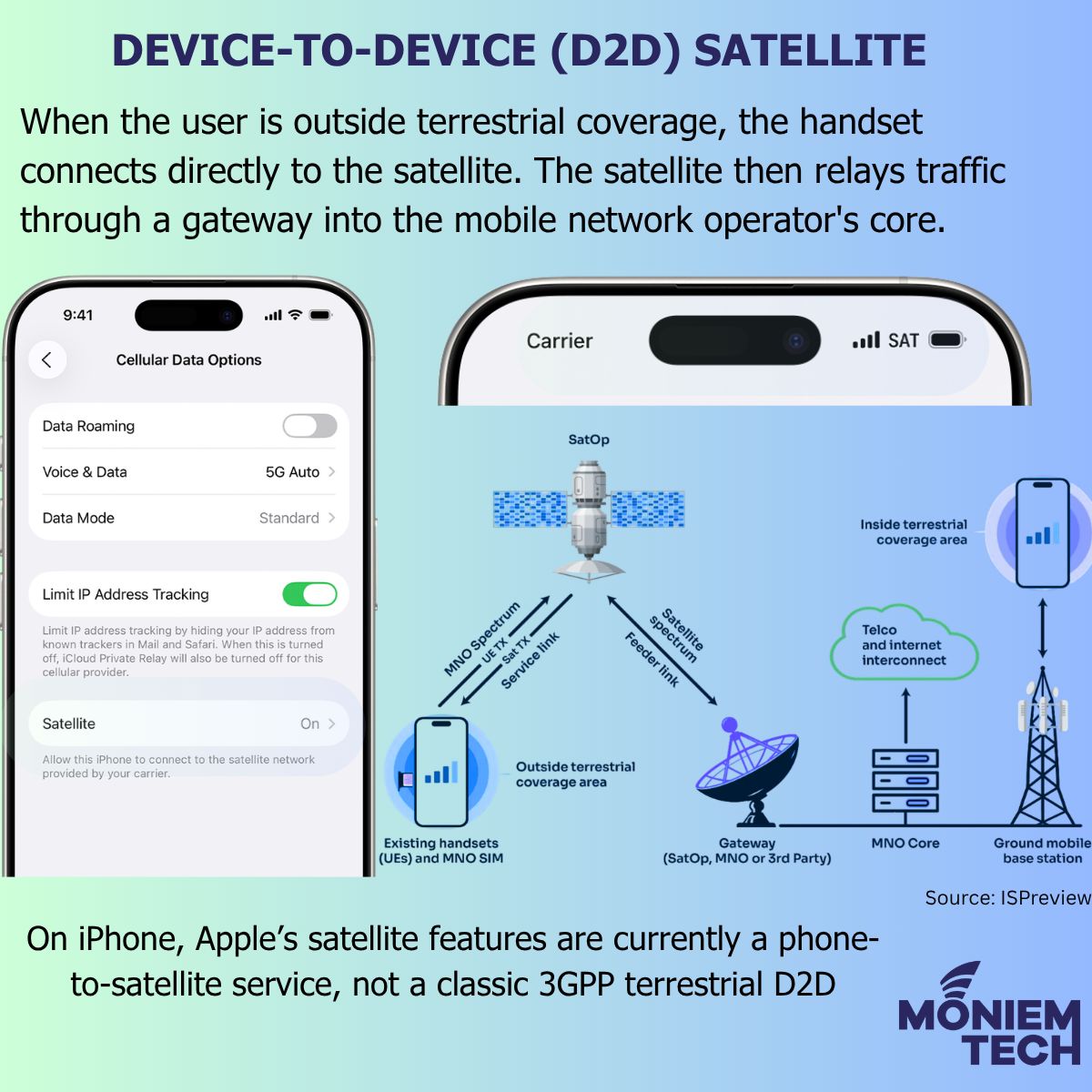
Outside terrestrial coverage (D2D satellite path): The handset connects to the satellite via a service link using MNO or satellite spectrum. The satellite relays traffic through a ground gateway. The gateway connects to the mobile operator’s core network.
Inside terrestrial coverage (Standard terrestrial path): The handset connects normally to a ground-based mobile base station. The base station connects directly to the mobile operator’s core network.
A note on the carrier-provided satellite on iPhone
- Apple’s own iPhone satellite features are phone-to-satellite services for emergency and off-grid messaging — they operate independently of any carrier.
- Carrier-provided satellite on iPhone is a separate capability. Supported carriers can provision satellite features indicated by a “SAT” indicator in the status bar — this is a carrier access model layered on top of the device.
- Both are satellite access models, but they represent distinct integration and spectrum arrangements.
As 3GPP Release 17 and Release 18 NTN specifications mature, the distinctions between these three models will sharpen further — particularly as standards-based NTN moves from IoT-grade services toward broadband NR connectivity. Tracking which model a given operator or vendor is pursuing is essential context for evaluating partnership announcements, spectrum strategy, and device roadmaps in this space.