
Carrier Aggregation (CA) combines multiple frequency blocks (Component Carriers) into a single larger channel, boosting speed, capacity, and coverage. It’s been around since 4G, but in 5G it’s evolved into something far more powerful.
4G LTE-Advanced Carrier Aggregation (CA), introduced in 2011 by the 3rd Generation Partnership Project (3GPP) Release 10, was designed to increase data rates by combining multiple fragmented spectrum blocks into a single logical channel.
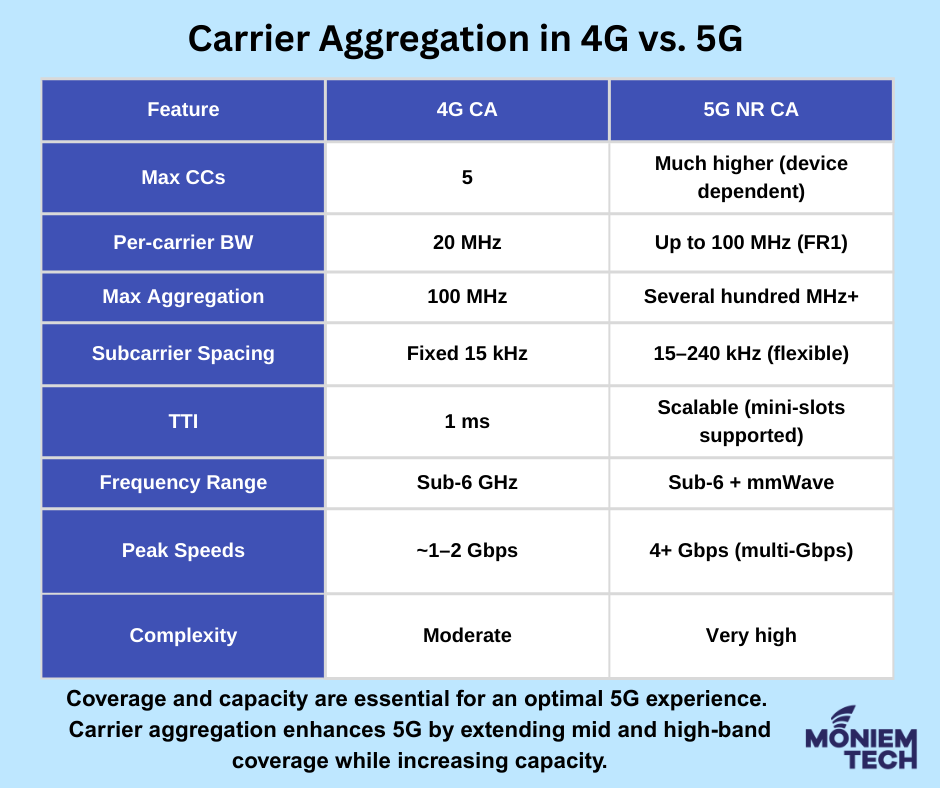
- It supports up to five component carriers (CCs), each with a maximum bandwidth of 20 MHz, allowing a total aggregated bandwidth of up to 100 MHz.
- LTE uses a fixed numerology with 15 kHz subcarrier spacing and a 1 ms Transmission Time Interval (TTI), which simplifies design but limits flexibility. Carrier aggregation in LTE-Advanced is primarily downlink-focused, and when combined with advanced techniques such as 4×4 MIMO and 256QAM modulation, it can achieve theoretical peak speeds of around 1–2 Gbps. However, because LTE maintains a rigid frame structure and fixed subcarrier spacing, it cannot efficiently scale to extremely wide bandwidths or ultra-low-latency use cases.
In contrast, 5G NR Carrier Aggregation, defined starting in 3GPP Release 15, is far more flexible and powerful.
It operates across both FR1 (sub-7 GHz) and FR2 (mmWave, 24 GHz+) frequency ranges and can aggregate low-band, mid-band, and mmWave carriers simultaneously.
- Individual carriers in FR1 can reach up to 100 MHz—five times wider than LTE’s maximum per carrier—, and mmWave carriers can be even broader, enabling several hundred megahertz of aggregated bandwidth.
- Unlike LTE’s fixed 15 kHz spacing, 5G NR supports scalable numerology with subcarrier spacings ranging from 15 kHz to 240 kHz, enabling adaptation to different frequency bands, latency targets, and deployment scenarios. This flexibility enables multi-gigabit data rates, commonly exceeding 4 Gbps, especially when combined with massive MIMO and beamforming. However, this also results in significantly greater RF and band-combination complexity, with modern devices supporting dozens of possible aggregation combinations.
Overall, while 4G CA focuses on combining limited spectrum to increase throughput, 5G NR CA offers a highly flexible, multi-layer spectrum approach designed for extreme bandwidth, low latency, and various deployment scenarios.
What the Numbers Say about 5G NR DC
This figure from Ericsson illustrates how mid-band TDD 5G coverage and user accessibility improve progressively through three architectural stages: Standalone NR, Non-Standalone dual connectivity, and inter-band NR carrier aggregation. It also quantifies both coverage gain (dB) and the percentage of subscribers benefiting at each step.
- Mid-band TDD alone reaches only 45% of subscribers in a coverage area. Add Non-Standalone Dual Connectivity, and that jumps to 67%. Add inter-band NR Carrier Aggregation, and you reach 84% of subscribers.
- Non-Standalone NR Dual Connectivity (EN-DC) delivers a +9 dB coverage gain over a Standalone NR baseline — CA then contributes an additional +7 dB on top of that.
- By activating inter-band NR CA, the mid-band TDD cell coverage area increases by 2.5x — equivalent to a 25% increase in the population covered.
- With more users offloaded from low-band onto mid-band via CA, overall network capacity increases by 27%.
Device Limitations — the piece operators often overlook
CA is only as good as the device in your hand. Key constraints:
- Chipset — the modem must explicitly support each band combination (as defined by the 3GPP spec). Two phones on the same network can have very different CA support.
- Antenna design — supporting simultaneous multi-band reception requires hardware investment, which is often cut from the budget.
- 4G devices typically support 2–5 CA combinations. Flagship 5G devices can support dozens.
- In 5G NSA, most devices support up to 2 NR carriers alongside LTE. Full 5G SA CA with 3–4 carriers is still rolling out.
- Budget/mid-range 5G phones frequently skip advanced CA band combinations — meaning a subscriber on a premium network plan may still experience mid-tier speeds simply due to device limitations.
The Bottom Line
In 4G LTE-Advanced, carrier aggregation (CA) mainly enhanced throughput. It enabled operators to combine fragmented 20 MHz carriers to boost peak data rates, but coverage was mostly determined by low-band FDD macro cells. Even without CA, LTE networks could provide extensive coverage because low-frequency spectrum managed mobility and reach, while CA primarily improved user experience in good radio conditions.
In 5G, especially with mid-band TDD spectrum like 3.5 GHz, the situation differs. Mid-band is core to 5G, offering a balance between bandwidth and propagation. However, it has higher path loss, uplink power limits, and TDD-specific constraints like guard periods and DL/UL switching, leading to coverage and uplink bottlenecks that limit user access and cell-edge performance without aggregation.