
The global telecom industry in 2025 presents a mixed picture of progress and imbalance. More people than ever are online, mobile broadband has become the norm, and 5G continues to expand rapidly. Yet beneath these gains, major gaps remain in network quality, affordability, and access to next-generation technologies.
Today, 74% of the world’s population uses the internet. That marks meaningful progress compared with a decade ago, but it also means 2.2 billion people remain offline. As a result, the industry’s central challenge is changing. The priority is no longer simply extending coverage to more people. It is now about addressing deeper structural divides across income groups, geographies, and network types.
Three figures capture this shift particularly well.
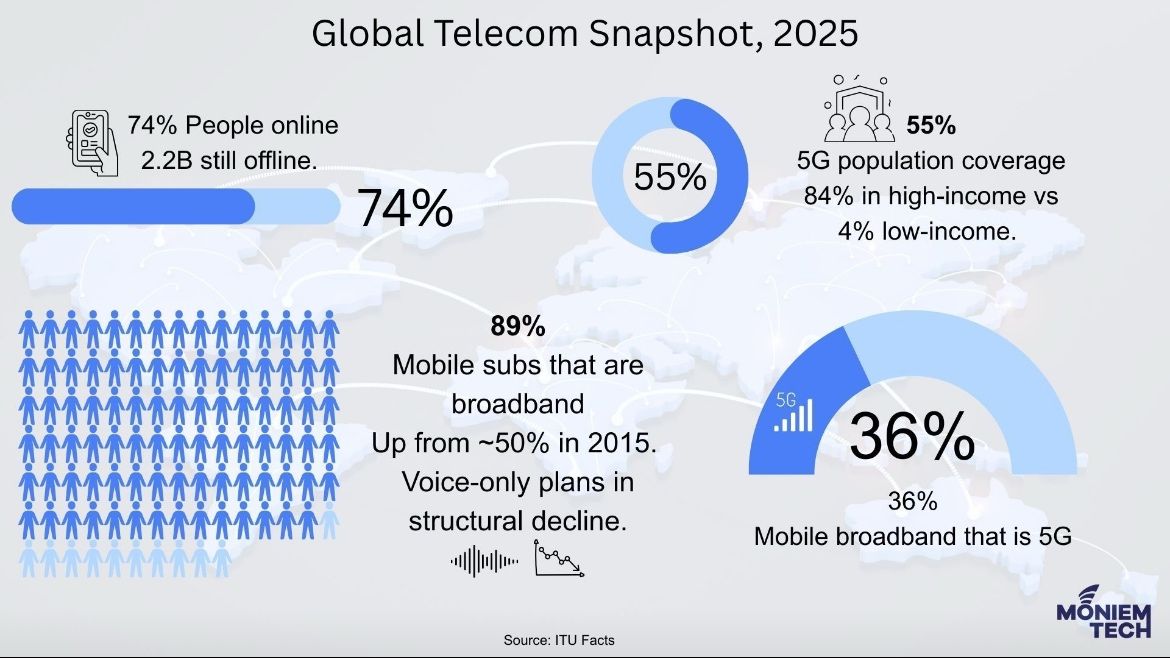
The first is that 89% of mobile subscriptions now use broadband, up from roughly 50% ten years ago. This reflects a major transformation in how people use mobile networks. Mobile connectivity is no longer primarily about voice and text. Broadband has become the global standard, reshaping consumer expectations and operator priorities. For telecom companies, this means competition is moving beyond basic access. Increasingly, success depends on delivering stronger network quality, greater reliability, and differentiated services that create real value for users.
The second key figure is that 5G now covers 55% of the global population. On the surface, that appears to be a strong milestone. However, the global average hides a stark divide. In high-income regions, 5G coverage has reached 84%, while in low-income regions it stands at just 4%. This is not merely a temporary rollout gap. It is a structural inequality that risks widening broader economic differences between countries and communities. Access to advanced connectivity increasingly influences productivity, innovation, digital inclusion, and participation in the modern economy. Where 5G is absent, those opportunities may be limited as well.
The third figure is that 36% of mobile broadband connections now run on 5G. This indicates solid momentum in adoption, but it also highlights that usage still trails network availability. In other words, building coverage alone does not guarantee take-up. The pace of 5G adoption will depend on factors beyond infrastructure, including device affordability, the availability of attractive data plans, the presence of compelling use cases, and whether consumers and businesses experience clear performance benefits from upgrading.
Taken together, these trends point to a telecom sector entering a more mature phase. The industry is no longer defined only by how far networks can reach, but by how effectively they perform and how equitably their benefits are shared. Coverage remains important, but it is no longer the sole measure of success.
That is the real story of telecom in 2025. The world has made real gains in connectivity, and those gains matter. But the next chapter will be defined less by expansion alone and more by execution: improving quality, narrowing inequality, and ensuring that digital progress delivers meaningful value for everyone.