
The problem slicing solves
A mobile network has always been a compromise. The same infrastructure must serve a surgeon monitoring a remote procedure, a teenager streaming 4K video, and a water meter reporting once a day. These use cases pull the network in opposite directions: one needs millisecond latency, one needs raw throughput, one needs to sip battery for a decade. Until 5G Standalone, the industry answered this with a single best-effort network plus traffic prioritization — everyone on the same road, with some cars allowed to nudge ahead.
Network slicing changes the model. Instead of one network trying to be everything, the operator carves the same physical infrastructure into multiple logical networks, each engineered and guaranteed for a specific purpose.
Think of a highway. Traditionally, all traffic — ambulances, trucks, commuters — shares the same lanes. Quality of Service (QoS) is a traffic officer waving the ambulance forward, but when the road is jammed, even the ambulance crawls. Slicing rebuilds the highway itself: a permanently reserved emergency lane (URLLC), an express toll lane (premium eMBB), a freight lane (mMTC), and general lanes for everyone else. Same asphalt, same land, but each lane has its own rules, its own reserved width, and its own guarantee. Congestion in the general lanes cannot spill into the emergency lane.
The analogy holds surprisingly deep. The asphalt is the shared physical layer — spectrum, radios, fiber, data centers. The lane markings are the logical partitioning. The toll system is the SLA and billing. And the road authority deciding which vehicle enters which lane is the slice selection machinery in the 5G core.
What a slice actually is
Formally, a network slice is an end-to-end logical network running on shared infrastructure, identified by an S-NSSAI (Single Network Slice Selection Assistance Information). The S-NSSAI has two parts:
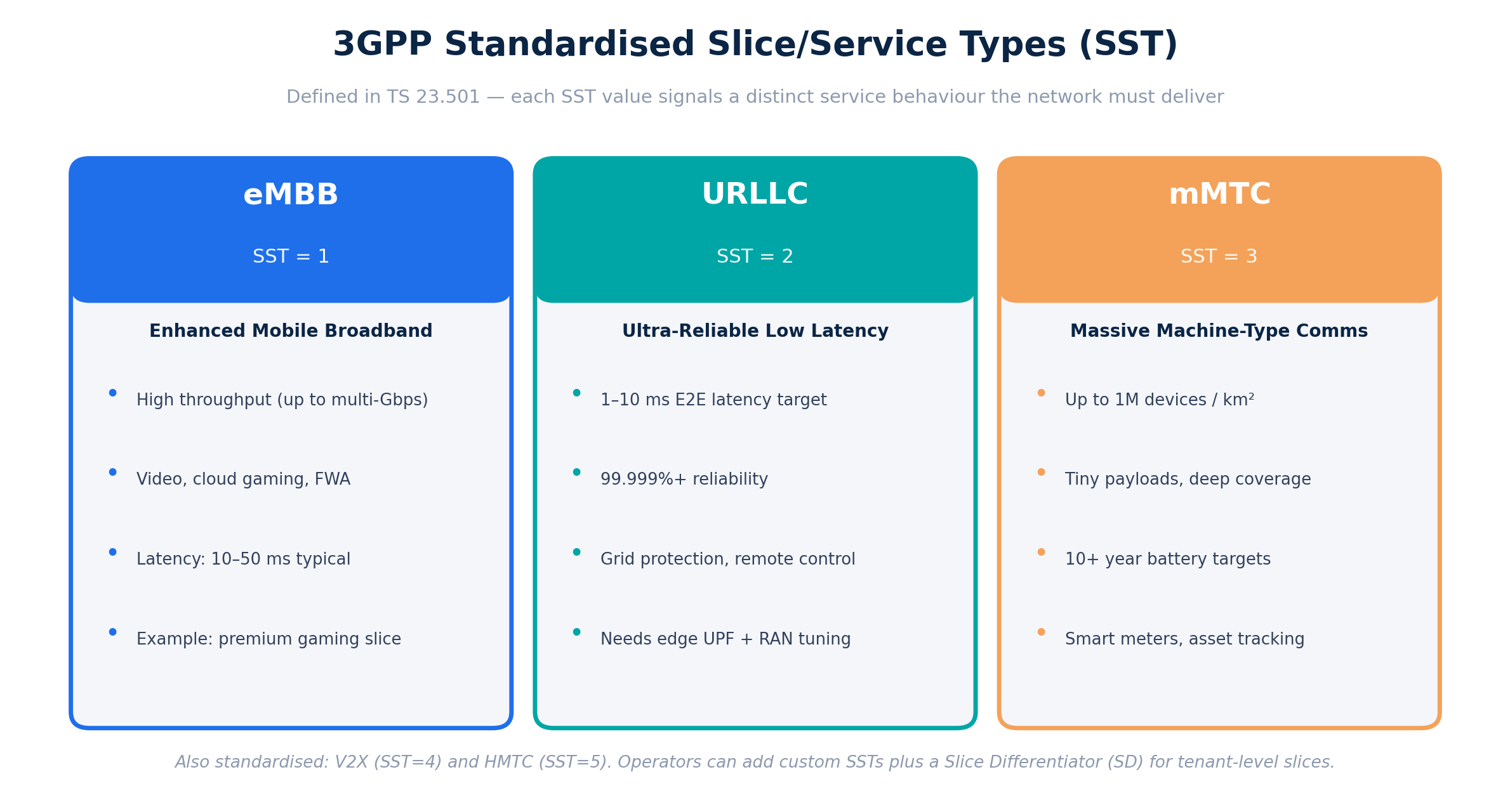
- SST (Slice/Service Type) — an 8-bit value declaring the expected behaviour. 3GPP TS 23.501 standardises SST=1 (eMBB), SST=2 (URLLC), SST=3 (mMTC), SST=4 (V2X) and SST=5 (HMTC).
- SD (Slice Differentiator) — an optional 24-bit value distinguishing multiple slices of the same type, for example separate URLLC slices for two industrial customers.
The critical word is end-to-end. A slice is not a core-network trick or a RAN scheduler setting. It spans four domains, and it only delivers its guarantee if all four cooperate.
1. The device (UE)
The handset or module must know which traffic belongs to which slice. This is handled by URSP (UE Route Selection Policy) rules pushed from the core’s PCF. A URSP rule might say: traffic from this gaming app, or to this enterprise APN/DNN, maps to S-NSSAI X. The device then requests a PDU session on that slice. This is one of the quiet bottlenecks of commercial slicing — URSP support across the device and OS ecosystem matured slowly, and without it, slice selection falls back to cruder methods like dedicated DNNs or physical SIM profiles.
2. The RAN
Radio is where isolation is hardest, because spectrum is finite and shared by nature. The gNB scheduler enforces slicing through RRM (Radio Resource Management) policies: a slice can be given a guaranteed minimum share of PRBs (Physical Resource Blocks), a maximum cap, or a dedicated partition. URLLC slices additionally lean on physical-layer tools — mini-slot scheduling, shorter TTIs, robust MCS selection — to hit latency targets. The design choice here is between hard slicing (dedicated resources, strong isolation, lower efficiency) and soft slicing (prioritized sharing, better utilization, weaker guarantees). Most commercial deployments start soft.
3. Transport
The often-forgotten middle. A slice’s latency budget can be destroyed in backhaul before packets ever reach the core. Transport slicing options range from soft (VLANs, VPNs with QoS marking, segment routing with traffic engineering) to hard (FlexE channelization, which partitions Ethernet at the physical layer, or TSN for deterministic delay). An operator selling a 10 ms SLA needs to know its transport can honor it at the 99.9th percentile, not on average.
4. The 5G SA core
This is why slicing is effectively an SA-only capability. The Service-Based Architecture lets the operator instantiate network functions per slice: a dedicated UPF placed at the edge for a low-latency slice, dedicated SMF instances, separate policy sets. The NSSF (Network Slice Selection Function) decides which slice instance serves each session, and the AMF can be shared or dedicated. NSA networks anchored on the 4G EPC simply lack this machinery — which is why markets with low SA penetration talk about slicing more than they deploy it.
Above all four domains sits orchestration: the NSMF/NSSMF hierarchy that composes, deploys, monitors and retires slices, ideally against a machine-readable template (GSMA’s Generic Slice Template, GST). Mature slicing is less a network feature than an automation capability — the ambition is slices created on demand via API, with NWDAF analytics closing the loop on SLA assurance.

Slicing is not QoS — and the difference is the business model
The most common conflation, including inside the industry, is between slicing and QoS prioritization.
[QoS Prioritization ≠ Network Slicing]
QoS, expressed through 5QI values, reorders packets within one shared network. It is relative: your traffic goes before mine, but under heavy congestion everyone degrades together, just unequally. There is no resource reservation and no enforceable SLA. In the highway analogy, QoS is queue-jumping; the road is still shared.
Slicing partitions resources. A properly engineered slice has capacity that other traffic cannot claim, which is what makes a contractual SLA — latency, throughput, reliability, availability — possible in the first place. And an SLA is what makes slicing sellable: enterprise private-network-as-a-slice, broadcast slices for event coverage, gaming slices sold direct to consumers, and network APIs (CAMARA/GSMA Open Gateway’s quality-on-demand) that let application developers request slice-like behavior programmatically.
Quality of service is a network engineering tool. Slicing is a product architecture — arguably the first mechanism that lets an operator price network behavior rather than volume. Airtel’s Fast Lane in India, gaming slices in China and Korea, and emergency-services slices in several European markets are early commercial evidence that the express-lane model has buyers.
Where it gets hard
Isolation vs efficiency. Hard slicing wastes capacity when the reserved lane sits empty; soft slicing risks SLA breaches at peak. Real deployments run dynamic resource sharing with guaranteed floors — engineering the floor correctly, per cell, per busy hour, is the actual work.
The weakest domain wins. A slice’s SLA is set by its worst-performing domain. A perfect core slice behind congested unsliced backhaul delivers nothing. This is why end-to-end orchestration and assurance, not any single-domain feature, is the true marker of maturity.
Ecosystem dependencies. Commercial slicing needs SA core coverage, URSP-capable devices, roaming agreements that preserve slice behavior across borders, and regulatory clarity on whether paid prioritized lanes conflict with net-neutrality rules — a live question in several jurisdictions.
Network slicing is the point at which 5G stops being a faster pipe and becomes programmable. The highway analogy captures the essence: same infrastructure, differentiated guarantees, and — for the first time — lanes you can sell. The technology stack (S-NSSAI, URSP, NSSF, RAN RRM partitioning, transport slicing, per-slice UPFs) exists and is standardized. What separates markets now is not the standard but the plumbing: SA penetration, device readiness, and the orchestration automation to run slices as products rather than projects.