
Dynamic Spectrum Sharing: A Proven Transition Enabler, Not a Long-Term 5G Strategy
Dynamic Spectrum Sharing (DSS) emerged as one of the most pragmatic tools in the 4G-to-5G transition, offering operators a way to accelerate 5G deployment without waiting for fully cleared or newly dedicated spectrum.
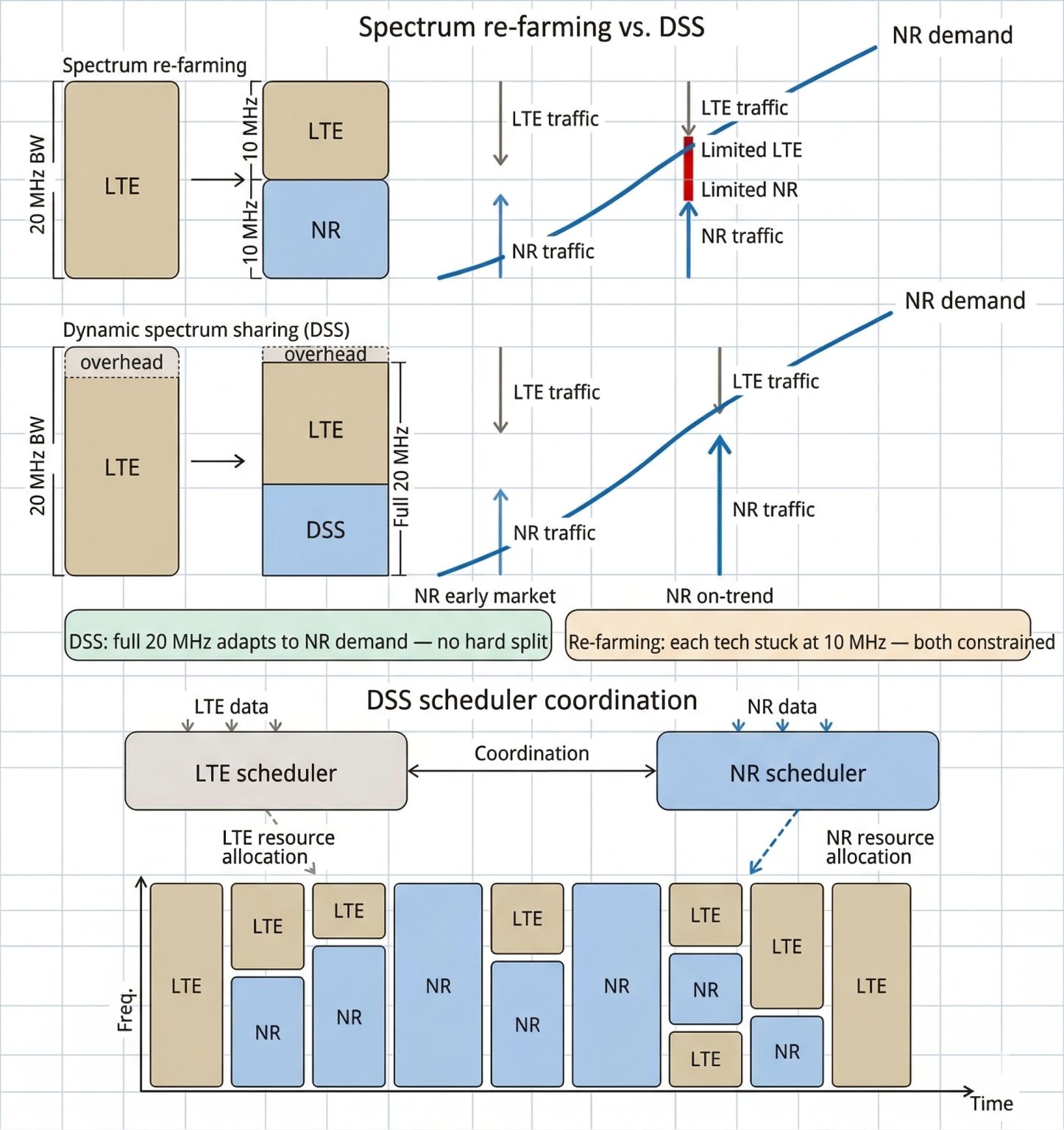
At its core, DSS enables operators to run LTE and 5G New Radio (NR) concurrently on the same spectrum carrier, with resources allocated dynamically based on real-time traffic demand. Standardized by 3GPP as part of the formal LTE-to-NR migration framework, DSS enabled operators to repurpose existing low-band LTE assets for early 5G coverage — a critical advantage at a time when newly licensed 5G spectrum was limited or only partially cleared.
In the early deployment phase, coverage reach held more strategic weight than peak throughput. DSS directly addressed that priority, enabling broader 5G footprints while maintaining continuity of service for the existing 4G subscriber base.
Technical Architecture
Resource allocation in a DSS environment is governed by the coordinated base-station scheduler, which arbitrates between LTE and NR in real time. Scheduling decisions factor in live traffic demand, user load distribution, and coexistence constraints — ensuring that both technologies share the carrier without static partitioning of spectrum resources.
Performance Trade-Offs
DSS is not without cost. Operating LTE and NR on a shared carrier introduces signaling overhead and scheduler complexity that dedicated spectrum deployments do not face. Empirical data indicate that DSS imposes a throughput penalty of approximately 25% on LTE and 15% on 5G NR relative to clean, single-technology deployments.
These reductions are generally considered acceptable during the transition period, given that the full spectrum block remains available to both technologies simultaneously. However, operators that rely heavily on DSS over the long term may find themselves at a structural disadvantage in terms of 5G peak speeds and capacity, relative to peers that have migrated to dedicated NR carriers.
DSS fulfilled a specific and well-defined role: it compressed the timeline for the large-scale launch of 5G and extended coverage into bands already in service, without forcing a hard cutover from LTE. For operators facing spectrum constraints or phased clearance schedules, it represented a sound near-term strategy.
That said, DSS was never architected as an endpoint. As 5G traffic volumes grow and operator priorities shift from coverage to capacity and performance, migration toward dedicated NR spectrum will become increasingly necessary. The operators best positioned for the next phase of 5G will be those that used DSS as a launchpad — not a long-term operating model.